April 14, 2026 • Nora Vale
What changed on this page. The earlier version was written as if by the operator: it claimed that this site had tested every major immersive platform and spoken with hundreds of early adopters, ranked features by their emotional impact, and printed a quote from a self-described VR pioneer that no reader can verify. None of that stands up, so it has been removed. What follows is what VR and AR casino products actually are, what immersion does to a session, and how to find out whether such a product is licensed at all.
What a VR or AR casino product actually is
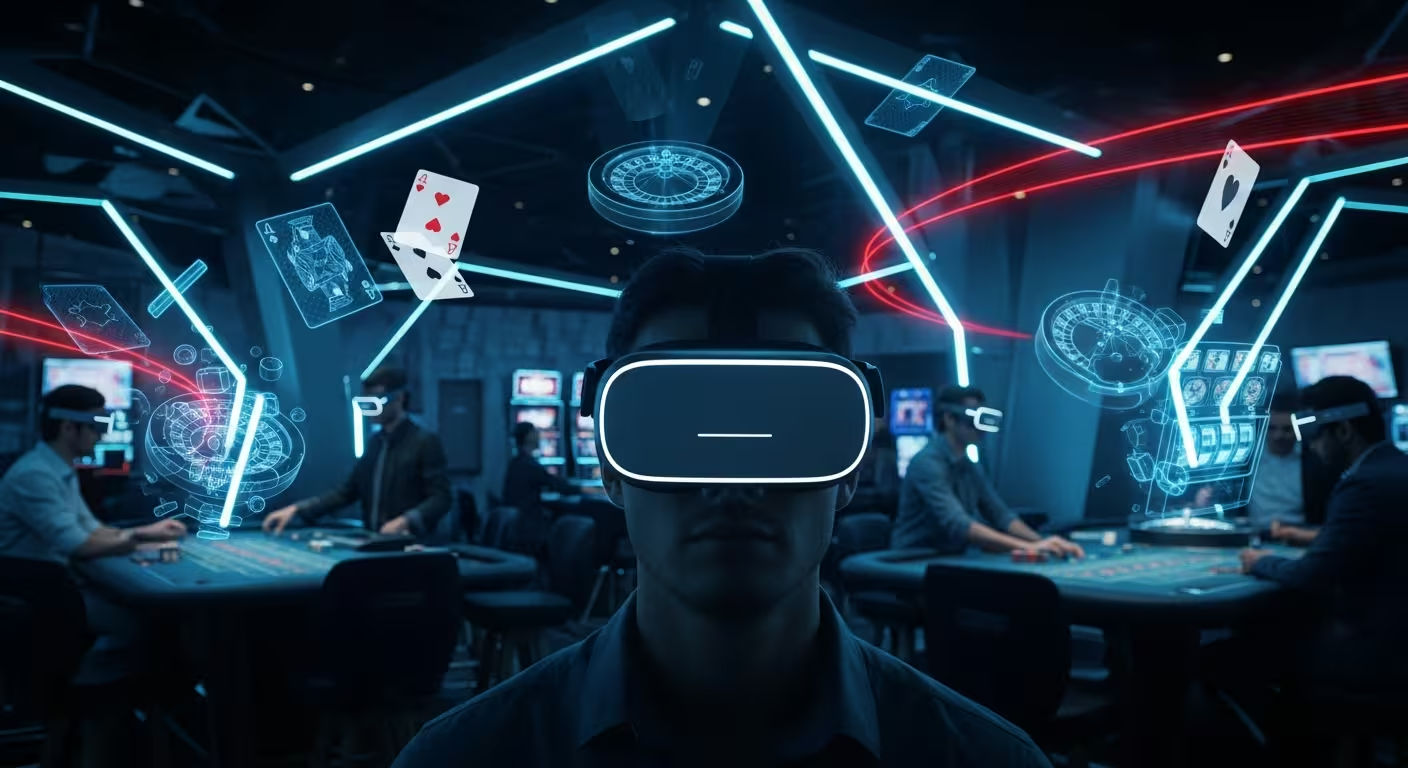
Strip away the marketing and three fairly ordinary things are on offer. The first is a three-dimensional lobby: a rendered room you walk through, with the same games running inside it that run in a browser tab. The second is live-dealer video placed on a virtual screen, so a real studio table is shown inside a rendered environment. The third is augmented reality on a phone, where a wheel or a card table is drawn over your camera view; in practice this is usually a showcase rather than a full product.
In all three cases the important part is unchanged. The round is decided on the operator’s server, by the same generator or the same physical wheel, and the headset is a display. Most of these products are web scenes that also open in an ordinary browser, which is why a title that looks exclusive to a headset is often the same game you can already play with a mouse. That is worth knowing before anyone tells you that a new device gives access to games you could not otherwise reach.
Immersion changes the session, not the odds
The real effect of a headset is on time and attention. A rendered room has no clock, no window and no reason to end; notifications are gone, the outside world is gone, and a round takes a gesture rather than a click. Everything in that list makes a session longer, and session length is the single variable that multiplies the cost of a fixed house edge. The table separates what the device genuinely changes from what it leaves untouched.
| What the headset changes | What it leaves exactly as it was |
|---|---|
| The room, the sound and the sense of scale | The generator that decides each round |
| Your sense of time, with no clock and no daylight | The independence of one spin from the last |
| How quickly a round starts, a gesture instead of a click | The house edge: 2.70% on European roulette, 5.26% on the American wheel |
| Who you feel you are playing with, avatars and voices | Who holds your money and which terms your account runs on |
| How memorable the evening feels afterwards | The return to player printed in the game information |
None of this makes immersive gambling worse than the flat kind; it makes it longer, and longer is more expensive at any edge. The useful response is mechanical rather than moral: a timer you can hear through the headset, a stake you fixed before you put it on, and limits set in the account. The habits that keep a long session from turning into a bad one are the same ones described in the honest version of gambling psychology, and they matter more here than in a browser tab because the exits are further away.
How to check whether the product is licensed at all
A licence covers a company and the domains it operates, not a headset, an app-store listing or a virtual world. The check takes about five minutes and does not depend on what the interface looks like:
- Find the operating company and the licence number, usually in the site footer or in the first clauses of the terms.
- Open the regulator’s own public register and search for that number. A badge on the page proves nothing; the register entry is the document.
- Check that the exact domain you are playing on is listed in that entry. Mirror domains and numbered variants are frequently not.
- Read which territories the licence excludes, because that is where a complaint would have nowhere to go.
- Confirm that the account terms, the limits and the withdrawal rules are the same ones inside the immersive product as on the ordinary site.
Run on this brand, the check produces a mixed result worth stating plainly. The operator holds an Anjouan licence, ALSI-202510034-FI1, and the Anjouan validator showed it as valid for safabet.com on 22 September 2026. That licence excludes a list of territories — Australia, Comoros, France, the Netherlands, Spain, the United Kingdom, the United States and every country on the FATF blacklist, which includes Iran — so players there sit outside the protection it offers, whatever the interface looks like. The site also displays a Curaçao eGaming seal, and that validator’s domain no longer resolves, so the second claim cannot be checked at all.
What to settle before you put the headset on
Decide the budget, the stake and the finish time while you can still see a clock. Set the deposit and loss limits in the account, not in your head, and put a timer outside the headset where it will interrupt you. Take the headset off for the breaks rather than pausing inside the scene: a break that happens in the same rendered room is not really a break.
Fatigue deserves its own line here, because an hour in a headset is more tiring than an hour at a screen and tired people hold to their limits less well. That is a genuine effect on discipline and nothing more; as the piece on routines and performance sets out, no amount of sleep, food or focus moves a house edge by a single decimal. It only changes how reliably you do what you already decided to do.
A practical takeaway. Treat an immersive casino as an ordinary casino with the exits further away: fix the budget and the finish time in advance, set deposit and loss limits inside the account, and keep a clock outside the headset. Never gamble on credit or with money meant for something else, and if gambling stops being fun, contact your national gambling support service; it is free and confidential.
Frequently Asked Questions
Is a VR casino fairer, or more rigged, than an ordinary one?
Neither, as far as the device is concerned. The round is decided on the same server by the same generator, and the headset only displays the result. Whether a particular operator runs tested software is a separate question, answered by a licence and a laboratory certificate you can look up.
Do VR and AR casinos offer a better return to player?
No. The return is a property of the game, not of the display, and it is printed in the game information screen in either format. If an immersive title advertises a better return than the same game elsewhere, read the information screen inside the game before believing it.
Can I tell from an app store whether a VR casino is licensed?
No. A store listing is a distribution channel, not a regulator. Find the operating company and licence number in the terms, then search for that number in the regulator’s own public register and check that the domain you play on is named in the entry.
Enjoy the room if the room is what you came for, and judge the casino by the register entry, the terms and the return printed in the game.